Keeping Cool with AC Efficiency Tips Without Losing Comfort
Whew! It is summertime and it is hot and muggy in Houston. Living in South Texas you can always count on the cooling season lasting longer than the heating season. It doesn’t take long for the AC to push the electric bill up and up. High bills entice people to seek cost-saving measures.
So many cost-saving measures are also expensive. Everyone agrees that new, energy-efficient appliances or solar panels will pay for themselves over time, they also require a hefty capital investment upfront. For many that will not happen this year. Here are six AC Effieincy solutions that can help you save significant dollars without spending a lot of dollars.
#1 AC Efficiency Tip: Avoid solar heat
Know the layout of your house in reference to the summer midday sun. The sun will move on the south side of your home, so make sure window coverings are blocking the harsh midday sunlight. Your windows may already be Low-E rated to reflect some of the sunlight. Blackout drapes help more than sheers. Blinds or shutters will also work. Keep the summer heat outside where it belongs.
#2 AC Efficiency Tip: Reduce appliance heat
Wait to run the washer, dryer, or dishwasher until the cool of the evening. The midday heat is also peak energy use hours, so run them during off-peak hours. They also produce heat, so running them during evening hours puts less load on the AC.
Summertime also lets you be creative with cooking meals—use that creativity to save energy as well. Cooking outdoors, use a crockpot or air fryer instead of the oven. Be creative and make it fun.
#3 AC Efficiency Tip: Move the air
Moving air inside your house makes the air seem cooler; it is the wind chill factor you hear about during Winter weather forecasts. It makes enough difference that the U. S. Energy Department says running a ceiling fan can allow you to raise the thermostat 40 without feeling a difference in comfort. S. Energy Department
Ceiling fan blades should run counterclockwise in the summer and clockwise in the winter. Running a ceiling fan cost about 2 cents/hour, significantly lower than running the AC for an hour. Ceiling fans are not the only option: wall or floor fans, tabletop or window fans work as well. Remember to use the bathroom exhaust fans while bathing or showering to remove heat and humidity.
#4 AC Efficiency Tip: Program the thermostat
If your thermostat is still a round dial on the wall, it is time to replace it with either a programmable or a smart thermostat. Both versions allow you to schedule changes in heating/cooling throughout the day and throughout the week. Smart thermostats also have a phone app that allows you to make changes on the fly.
How much can you save? The U. S. Energy Department says setting the thermostat back 70—100 for 8 hours/day can save around 10% on heating or cooling. Consider reducing HVAC use during sleeping hours or during the day, while the house is vacant. Schedule a transition 30 minutes before the family awakes in the morning or arrives home from school or work.
The key to cost savings is to find times when you can reduce HVAC use for 6 to 8 consecutive hours. Do some research, since there are several manufacturers; find a new thermostat with the features that fit your family’s needs.
#5 AC Efficiency Tip: Find air leaks
If your home seems drafty, is unusually humid, or has hot/cold spaces, look for gaps around doors, windows, and utility openings where outside air is moving inside.
-
- Do a visual inspection, looking for obvious cracks and holes.
- Use an incense or smoke stick. Light the stick, bring it in the proximity of windows and doors, watching for drafts in the smoke movement. You can also use very thin tissue paper to detect drafts.
- An energy audit with a certified technician. An audit employs inspection equipment, such as thermographic scans or infrared photography to locate thermal breaks causing energy loss. It will also use a blower door test that increases the indoor air pressure to locate gaps in walls and ceilings.
- Air leaks in common around windows and doors, around electrical outlets and switches, in the attic, basement, or garage. Caulk or seal gaps that you find with weather stripping.
#6 AC Efficiency Tip: HVAC TLC
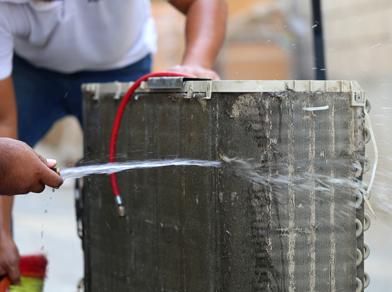
If you take care of your HVAC system, it will take care of you. Schedule an air filter change on your calendar; change the air filter every 3 months minimum, more if needed. Remove leaves, debris, and trash from around your outdoor compressor unit. Use a garden hose (not a power washer) to thoroughly clean the compressor.
Wind and rain deposit sediment between the fins, which reduces cooling efficiency. Make sure the return air and supply vents are uncovered to provide good airflow. Call your HVAC professional and schedule an annual PM visit to ensure your system is clean and in good repair.
Need Help With AC Efficiency?
If your home’s air conditioning needs its AC efficiency rebooted, call AllCool AC & Heating at 281-238-9292 or contact us via email.