Why is my HVAC System Will Short Cycle?

Why is my HVAC System Will Short Cycle?

AC Repair: Understanding the Short Cycle

During normal operations, you should hear your furnace complete 2 or 3 heating cycles per hour, with each cycle lasting approximately 10 to 15 minutes. During extremely cold days or if a home is poorly insulated, heating cycles may be slightly more frequent or last a little longer. However, if heating cycles come very quickly and end just as quickly, this is a condition called “short cycle.”

A short cycle happens when the furnace heats the home successfully, reaching the temperature setting indicated by the thermostat. However, the cycle ends before the air has time to mix and circulate, so rooms that are the most distant from the thermostat are still cold. The cold air forces the thermostat to call for another heating cycle, which, again, ends too soon.

4 Hidden Reasons Your Furnace Will Short Cycle

Short cycles indicate one of several underlying problems that need to be addressed. They include:

A Wrong-sized Furnace. Before a furnace is installed, a technician completes a J-Load calculation, measuring the square footage, insulation value, window and door openings, and other factors about the home that affect heating and cooling. The calculation indicates the proper size furnace, measured in BTU output. A system too small will struggle to keep a home warm with “long cycles,” and a system too large will cause “short cycles.” Both cause furnaces (and air conditioners) to run inefficiently and wear out too quickly.

A Dirty Air Filter. The furnace is working to create sufficient warm air to make a home comfortable. But a dirty filter will reduce the airflow needed to move the heat throughout the home. Dust and other airborne particles collect on the surface of the filter until the filter is completely covered. For this reason, an air filter needs to be changed about every three months (more often if needed).

Thermostat Malfunctions. A properly placed thermostat will be installed on an inside wall, and out of direct sunlight. It functions best when placed in a central spot in the home. If the thermostat is improperly placed, it should be moved. Thermostats are battery-powered, so remember to change the battery annually. Occasionally, thermostats experience wear and need to be recalibrated. A malfunctioning thermostat will cause a furnace system to have short cycles.

Malfunctioning System. An aging or worn furnace may experience electrical or mechanical problems that create the conditions for short cycles. A heat pump that loses refrigerant will also lose the ability to collect heat from outdoors: the blower motor will continue to blow, but the heat will be missing from the coil. Wear can also affect sensors and control mechanisms, including capacitors and control boards (small computers).

If your furnace system begins to exhibit any short cycle tendencies, try these tasks in this order.

  1. Purchase a supply of air filters and change the filter. Observe the furnace to determine whether the short cycles have ended. Make sure to change the air filter regularly.
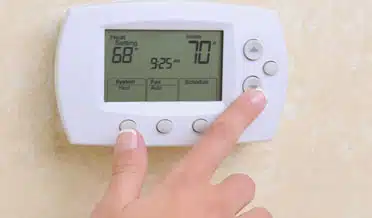
  2. Check the thermostat settings. Ensure that it is on HEAT or EM/AUX HEAT and that the temperature setting is at least 5 degrees lower than the temperature indicated on the thermostat face.
  3. If the settings are correct, turn the thermostat OFF temporarily and change the battery (or batteries). Observe to see whether the short cycling has ended.
  4. Check the vents and registers around the home. Make sure all are uncovered, since covered vents will reduce circulation.
  5. If short cycles continue, call your furnace/air conditioner technician for maintenance and repair.

Stop the Short Cycle Today

If your system is trapped in a persistent short cycle, ignoring the problem can lead to sky-high energy bills and premature equipment failure. These rapid bursts of activity put unnecessary strain on your HVAC components, often indicating a deeper issue like a faulty sensor or an improperly sized unit. Our professional technicians have the tools and experience to diagnose your system and restore perfectly balanced comfort to every room in your home. Call All Cool AC & Heating today at 281-238-9292 to schedule your AC maintenance appointment and get your system back on track.

Don’t Get Left in the Heat: Knowing Its Time For an AC Replacement

AC Replacement

Don’t Get Left in the Heat: Knowing It’s Time For an AC Replacement

Since a home is such a large part of a family’s investment portfolio, homeowners are wise to learn about a home’s building systems and keep them maintained. For instance, homeowners should know the age of their roofing shingles, carpet, and windows, and have a general idea of how soon they will need to be replaced. Another important building system to investigate is the air conditioning system.

Air conditioners are complex electro-mechanical systems, with four major functions:

  • Air conditioners cool the indoor space, making it comfortable and healthy for human habitation
  • Air conditioners remove excess humidity from the air for comfort and health
  • Air conditioners have a filtration system and clean the air with every cooling cycle
  • Air conditioners move air to ensure every area of the home is receiving fresh air

Homes are very difficult to maintain as abodes in South Texas without air conditioning. Knowing when to repair and when to replace an air conditioning system is part of wise homeownership. Here are some basic tips about air conditioners to help homeowners with decisions concerning replacement at just the right time.

Know When You Need an AC Replacement

Knowing the age of the air conditioner is an important first step. If you were not the owner during the last AC replacement, find the information on the model number plate. The manufacturer’s website can tell when the unit was built. Quality air conditioning systems will last between 15 and 20 years. Annual maintenance and regular air filter changes may add a few years. If your AC system is older than this, make plans for replacement soon. The goal might be to nurse it along for as long as possible, but an emergency replacement can be expensive and very inconvenient compared to a planned replacement.

Know Why You Need an AC Replacement

  1. Like any system in use, the parts eventually begin to show signs of wear. There are a few moving parts in an AC system. Two motors turn fans that assist with heat transfer, one inside the air handler cabinet and one outside in the condenser unit. It is easy to understand wear and tear on moving parts. But wear and tear also happen to electrical parts—switches, sensors, and control units.
  2. Wear will lead to repair visits to replace certain failing parts. Eventually, a large enough component will fail so that the repair cost rivals the cost of replacing a system. Keep a tally of repair costs and make sure that the cumulative costs of repairs do not climb too high.
  3. Perhaps the first indication of a problem is that the air conditioner is beginning to perform poorly. The air coming through the vents might be warm, not cold. The air conditioner might struggle to keep up during prolonged heat waves, forcing longer-than-normal cooling cycles. Certain rooms or spaces might never seem to get cool. The relative humidity indoors is very similar to outdoor humidity. There might be a simple solution, like a clogged air filter. If not, the solution might be attributed to a weakened air conditioner system.
  4. The clues might come from annoying smells or loud noises. The smells might seem sour or mildewy. The sounds might be loud, banging, or buzzing. They will not go away on their own and are often indications of a rapidly failing system.

Clear indications of an imminent catastrophic failure often include most or all of these signs–an aged air conditioning system that performs poorly, is expensive to keep running because it keeps making noises and smells foul. A wise homeowner will begin making plans for an AC replacement as soon as these signs begin to appear.

All Cool AC & Heating AC Installation professionals can assist with your HVAC repair and AC maintenance needs. Schedule your service or replacement appointment by calling All Cool AC & Heating at 281-238-9292 or contact us via email, and let our NATE-certified AC maintenance technicians put their experience to work for you.

AC Replacement Katy: Choosing the Right Size AC Unit

AC Replacement Katy

AC Replacement Katy: Which Size AC Unit is Right For Your Home

AC Replacement is no small investment! If you anticipate the purchase of a new air conditioner or HVAC system, make sure you have enough information to ensure that your purchase is a good fit for your home. HVAC technicians will use acronyms and technical terms during the conversation, so make sure you understand the lingo.

The Right Size

The most important factor is properly sizing the air conditioner for your space. But what does that mean—the proper size? It will need to be large enough to handle the cooling need of your home, at your location, with the construction material and methods of your home.

  • An air conditioner will need to cool a specific space, so the size of the AC will be based on the square footage of your home. You would expect an air conditioner for a 2,400-square-foot home to be larger than an air conditioner for a 1,200-square-foot home. If you need to find the square footage of your home, multiply the measurement of the length and width of the home. Having a general idea about the ceiling height of your home will be helpful later.
  • An air conditioner “moves” heat from the inside to the outside and the right size moves adequate heat to cool the space. The heat is measured in British Thermal Units or BTUs—the energy needed to heat one pound of water one degree Fahrenheit. Twenty BTUs are required to cool one square foot.
  • The measurement a technician uses is the ton, but it is not a measurement of weight. One ton of air conditioning function can cool 600 square feet, so 1 ton is equivalent to 12,000 BTUs.
  • These figures help you determine the general size or tonnage during the AC Replacement process.

Variables

Some specific details can be added to general specifications to help determine the appropriate size of an AC Replacement for your home and location. For instance,

  • You may reduce the needed capacity by 10% if a room is shaded during the heat of the day.
  • You must increase the capacity of a room if a room receives harsh sun during the day.
  • Add 600 BTUs for occupants above two people.
  • Add 4,000 BTUs for the kitchen.

Other variables, including the number of windows and doors, building materials, and insulation affect the cooling need. When a technician accumulates all the data gathered for his “load calculation,” a total BTU figure is calculated, and the proper tonnage of the air conditioner is determined.

Efficiency Standards for an AC Replacement Katy, Tx

The Department of Energy has established manufacturing standards to protect consumers by ensuring air conditioners function properly. Each model air conditioner is given a seasonal energy efficiency rating or SEER rating. In 2023, the DOE made upgrades to its standards, so new units will have a SEER2 rating. New AC systems use the latest in refrigerant technology and are very efficient.

Both the ton measurement and SEER2 rating can be found on the model # plaque. The designation for the smallest unit, 1.5 tons, is 18 and for every increase in .5 tons, the model number adds the number six. So,

1.5 tons = 18

2.0 tons = 24

2.5 tons = 30

3.0 tons = 26, and so on

Finding the ton indicator on the model number plaque will help you understand the size of your old air conditioner system. If your home has seen modest change—a room addition or remodeling project—expect the size of the new system to change drastically. If not much has changed, a change in size should be minor.

Considering an AC Replacement in Katy, Texas?

Schedule your free AC Replacement consultation by calling AllCool AC & Heating at 281-238-9292 or contact us via email and let our NATE-certified HVAC technicians put their experience to work for you.


3 New Rules for AC Systems

3 New Rules for AC Systems

AC Systems Rules for Homeowners

Two federal regulatory agencies regulate the manufacturing of heating and air conditioning (HVAC) systems, and both have regulatory upgrades that took effect on January 1, 2023. Regulatory changes are made with long-range environmental health in mind. These upgrades affect the choices available to consumers who need to replace their HVAC systems in homes and businesses. Without getting super technical, here are some simple explanations of the regulatory changes.

SEER Improvements

In 1992, the Department of Energy introduced Seasonal Energy Efficiency Ratings for new central air conditioning products (EER ratings for room air conditioning). It was based on testing completed in laboratory settings that measures the cooling output of a system compared to the energy used. SEER is a long-range measurement, over an entire cooling season and not a snapshot reading. Larger SEER numbers indicate greater energy efficiency.

The same federal agency oversees energy efficiency requirements in automobile manufacturing; the mpg rating for new cars is much higher than new cars a decade ago. Overseeing energy efficiency is done to lower our dependence on fossil fuels and reduce the total carbon footprint of the nation.

SEER requirements have been stepping up incrementally and 2023 is the year for the next efficiency upgrade. For the region that includes Texas, the minimum SEER rating for available air conditioner systems moves from 14 to 15. Manufacturers and contractors have been aware of this change for years, so the old stock of SEER 14 has been moved to other regions and only SEER 15 products are available locally.

SEER 2 Implementation

Researchers, always looking to improve their processes, noticed a slight difference between the measurement methods in laboratory settings and the actual energy efficiency capability that can be produced in the field. A new designation was developed to reflect the current means of measurement, so the new HVAC systems will have a SEER2 designation. This is an internal DOE implementation and has nothing to do with air conditioning operations in your home.

AC System Refrigerant Gas Changes

While the Department of Energy is overseeing air conditioner manufacturing, the Environmental Protection Agency is overseeing the production and distribution of the refrigerant gas used in the cooling process.

  • Air conditioning uses a mechanical-chemical process, called heat pump technology. By compressing and suddenly releasing pressure on certain gases, the system moves heat from inside to outside. In some cases, the process can be reversed, moving available heat outside to inside, to heat a home.
  • Scientists have used a variety of refrigerant gases over the years to cool indoor spaces. Some of these gases were discovered to be harmful to the environment, even depleting the ozone layer at the edges of the atmosphere. Ozone deflects significant amounts of ultraviolet radiation. These gases have been phased out and replaced with newer, more environmentally friendly choices.
  • In 2023, a few more gases are being phased out for more environmentally friendly gases. New systems will use new refrigerants; expect to see R-32 designations for new systems.
  • Some new products will also use an A2L type of gas. While the efficiency rating is very high, they are mildly flammable. A new HVAC system might have consumer warnings, denoting this fact.

All Cool has been tracking the regulatory climate and offers only compliant products. We are trained on the new equipment and gases. Existing systems that use older-style refrigerants can still be serviced, including adding gases as needed; we are also equipped to service and repair older systems.

Is Your AC System Effected by New Regulations? Let us help you decide!

Schedule your free AC System consultation by calling AllCool AC & Heating at 281-238-9292 or contact us via email.


6 Reasons to Consider an AC Replacement

6 Reasons to Consider an AC Replacement

AC Replacement Tips You Need to Consider

When you turned the air conditioner on this spring for the first time, was there a little apprehension? Did you wonder, “Is this the year that we must replace our AC?” If you are pondering an AC Replacement, here are some concerns that might help make a good choice—both negative and positive reasons.

Harsh Realities

Old Age. Unless you dig old cars, you frequently make decisions concerning how long to keep a car, since age and wear take their toll on common mechanical systems. The same is true concerning your AC unit; over time, components experience wear and tear and need to be repaired. Fifteen years is a milestone for air conditioners: if your system lasts longer—bonus. After fifteen years, it is in your best interest to plan a replacement.

Diminishing Returns

Perhaps you have had a few scares; your system stopped working, but a technician was able to bring the system back. Frequent expensive repairs lead to failure and at some point, pumping money into a failing system does not make economic sense.

Catastrophic Failure

Oh, yes, it can and does happen. It often happens during extreme temperatures; the added stress causes a failing system to collapse. Restoring an old system will eventually become too expensive when compared to replacing the system.

Pleasant Results

Cool Air. If your air conditioner quits on a hot summer day, installing a new system is a great relief. Yahoo!! Nothing will cause you to appreciate air conditioning like the lack of air conditioning. Air conditioning keeps your family both comfortable and healthy.

New Technology

While your old air conditioner has been working hard, researchers and engineers have been developing new, more efficient components and refrigerant gases. Not only will an efficient system save energy and money, but it will also improve our environment.

Peace of Mind

A new air conditioning system promises to provide relief, comfort, and safety for years to come. If something unexpected happens, warrantees generally take the brunt of any repair costs. Properly maintaining a new system will prolong its useful life, letting you breathe easily for years to come.

Let us help with your AC Replacement!

Schedule your free AC Replacement consultation by calling AllCool AC & Heating at 281-238-9292 or contact us via email.